

Your customer LTV is not a metric to measure every once and a while and then forget. It’s the core engine to your business’s long term profitability. It’s the final scoreboard for nearly all finance decisions that most founders typically take a finger in the wind approach to “figure out as we go.”
That’s why their unit economics always seems to fall short.
Three levers, compound math:
Take a customer paying $5,000/month, with 10% monthly churn and 60% gross margins ($3K in gross profit) buying one service. Base LTV: ~$30K (average 10 month lifetime).
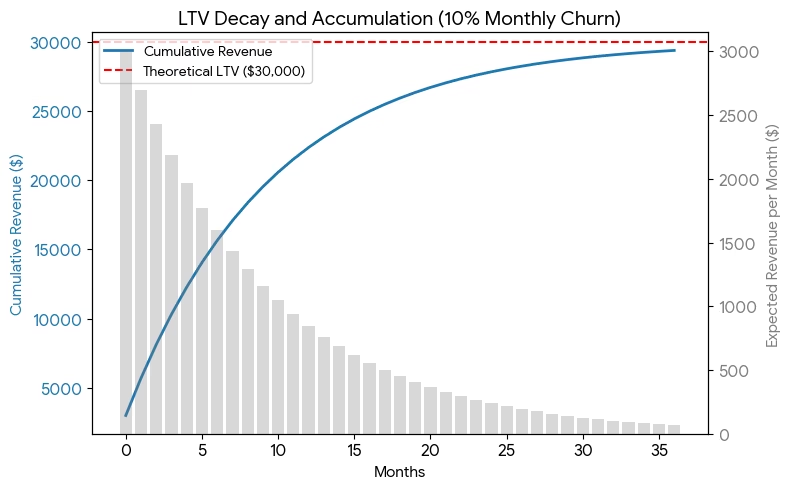
The good news about LTV is that there are several levers to pull when we want to improve it. When stacked, you get powerful outputs.
Take for example, these three LTV-connected moves:
- +10% on base price. LTV goes to ~$35K.
- -2% percentage points on churn. Average customer life extends from 10 months to 12.5. LTV goes to ~$37.5K.
- Add A Cross-sell. + $500/mo in gross profit increase / client. LTV goes to ~$35K.
All great moves that yield 17%-25% growth alone, but the real magic happens when these changes are stacked. Combined, you end up with a new LTV of ~$50K. That’s 67% growth which would be a phenomenal outcome for most businesses over the course of a year.
Same customer. Same product. Same business. Just finance applied deliberately.
Why this matters beyond LTV
The LTV line item is never the interesting part. The interesting part is what it unlocks downstream:
CAC tolerance. At $30K LTV and a 5:1 target LTV:CAC, you can’t spend more than $6K to acquire. At $50K LTV, you can spend $10K. Your entire go-to-market model loosens.
Payback period. With cross-sells attached, payback on CAC reduces dramatically and cash flow gets easier.
Enterprise value. For businesses working towards an exit, stacking LTV improvements like this significantly improves enterprise value, as your company becomes more stable, more profitable, and grows faster.
In my experience, this is often a much easier solution for growth than doubling your GTM strategies.
What Proview does:
In the first 60 days with a client we rebuild LTV from scratch. Not a vanity number – but a model with named levers, quantified impact, and a quarterly plan to drive improvement. We then execute the plan with the team, and watch LTV move. This takes continual effort and monitoring but it’s one of the most reliable ROI moves we make.
Want us to model your LTV levers? Send me a message or book a call for a 30-min finance walkthrough.