

Most SMB founders pay themselves the same way they set their services’ pricing by feel, by what the bank account allows that month, or by what the next guy is doing. This is a massive issue and will always leave you shooting from the hip either choking your business out of cash flow or building mounding resentment as you give and give without seeing anything in return.
It is one of the most expensive decisions in the business – and almost no one models it.
Two failure modes, one root cause
The over-drawer. Revenue grew, margins felt healthy The founder pushed their monthly draw from $10K to $25K. Nine months later cash flow is getting clunky, hiring and team raises are at a standstill, and the business has started feeling “tight”.
The under-drawer. The founder still pays themselves nothing as $1 mil. ARR. They tell themselves it’s discipline when in reality, its 1. a crutch for underperforming profitability or 2. they’re quietly resenting every employee who out-earns them.
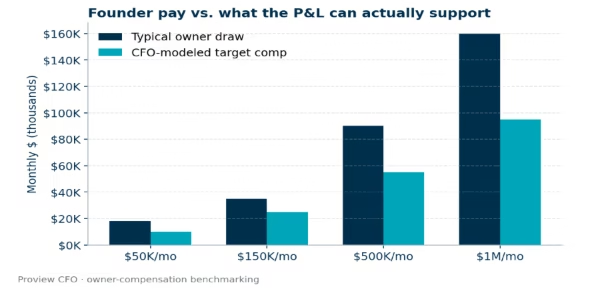
Both problems have the same root: no one ran the math on what the CEO seat is actually worth at this stage of the business.
Our founder-comp framework
We model owner compensation against three anchors:
1. Role market comp. What would you pay a non-founder CEO with your responsibilities and skill level, at your revenue level, in your geography?
2. P&L tolerance. What can your trailing 3-month net income actually support without starving reinvestment? We cap draw at 35–45% of true net income pre owner’s comp.
3. Cash runway. What draw keeps at least 90 days of operating runway intact? No exceptions!
Use whichever number is lowest.
The chart gives a snapshot of an over drawer vs. Idea CEO comp:
How to do this:
Pull your last three months of real net income (accrual basis).
Look up median CEO comp for your unique situation.
Check your cash balance and fixed operating expenses will you have at least 3 months of runway?
This simple framework will give you a directionally correct plan to pay yourself the right amount not too much that will choke out the business, and not too little that it doesn’t feel worth it.
NOTE* this is a general guideline and fits in more broadly into a discussion about capital allocation. This hinges on your goals for the business whether it be cash flow, scaling to sell, etc. Whatever your plan, this simple framework is a great exercise to run.
Want help modeling yours? Reach out or send me a message – happy to help!